Injuries aren’t just about healing—they’re about getting back to the activities that define your lifestyle. Whether you’re an athlete, enjoy the outdoors, or simply stay active, conventional care often leaves you cautious and limited. What you need is restorative care that heals your injury while preparing you to move with confidence and resilience.
Dr. Kelly Lally and their team at StretchClub® in Oswego specialize in restorative care specifically designed for active people. Our doctor-designed programs blend PNF techniques with dynamic partner-assisted stretching to systematically restore your mobility, rebuild your athletic capability, and retrain your movement patterns so you can return to your sport, your activities, and your lifestyle without hesitation.
The Active Lifestyle Injury Challenge
Active people face a unique recovery challenge: it’s not just about healing—it’s about returning to demanding activities that require strength, mobility, coordination, and confidence. A desk worker may be fine with basic pain-free movement, but you need your shoulder for overhead pressing, your ankle for cutting and lateral movement, and your core for explosive power. Conventional rehab rarely prepares you for these demands.
Most injuries stem from movement dysfunction, muscle imbalance, or poor neuromuscular control—not bad luck. A runner’s knee pain often comes from hip weakness, a climber’s shoulder injury from scapular and thoracic restriction, and a tennis player’s elbow from weak trunk rotation and wrist stability. Addressing these root causes is essential to prevent re-injury.
Why Generic Rehabilitation Fails Active People
Standard physical therapy protocols are designed for average recovery—getting people moving again without pain. They’re not designed for athletic demands. You complete therapy, you’re pain-free, and you try to return to your sport—only to feel unstable, uncomfortable, or even re-injure yourself because your body isn’t prepared for athletic demands. What’s missing is sport-specific progression, proprioceptive development, and progressive return-to-activity training.
Effective restorative care for active lifestyles requires understanding your specific sport or activity, assessing the demands it places on your body, and progressively building your capacity to meet those demands.
Comprehensive Injury Assessment for Active Individuals
Restorative care begins with understanding your injury and your demands. We assess your mobility, strength, and movement quality across multiple planes and demands. We evaluate your sport-specific or activity-specific movement patterns. We identify the movement dysfunction that contributed to your injury. We determine what demands your activity will place on your recovery.
This comprehensive assessment reveals not just what’s injured, but why the injury occurred and what your body needs to handle your activity safely. Someone recovering from an ankle injury to return to soccer needs a different treatment plan than someone recovering from the same ankle injury to return to hiking. Someone with a shoulder injury hoping to return to climbing needs different preparation than someone recovering from a shoulder injury to return to swimming.
Dynamic Mobility Restoration for Athletic Performance
Injured tissues become restricted through protective tension and immobilization. Your nervous system tightens muscles around the injury to limit potentially dangerous movement. While protective initially, this restriction becomes limiting when you’re trying to return to athletic demands. Dynamic partner-assisted stretching systematically releases this protective restriction, restoring the mobility your sport requires.
Unlike passive stretching, dynamic stretching under professional guidance creates genuine neurological change. Your nervous system experiences that full range of motion is safe during athletic demands. Your muscles learn to lengthen without triggering protective tension. The result is mobility restoration that supports athletic performance, not just basic function.
Strength Building for Athletic Demands
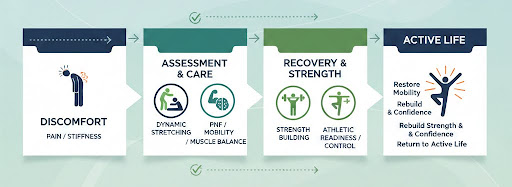
Rebuilding strength after injury requires progressive loading that respects healing while systematically challenging your tissues to perform athletically. We begin with activation and movement quality, progress to controlled strength building, then advance to dynamic, sport-specific strengthening and power development.
Throughout this progression, we emphasize movement quality over sheer force. Poor movement patterns under load just reinforce the dysfunction that caused your injury. Our approach ensures you’re building strength with proper movement mechanics, proper muscle activation patterns, and proper nervous system control. The result is genuine athletic capability, not just muscle size.
PNF and Proprioceptive Development for Return-to-Sport Confidence
Athletic performance demands proprioceptive control—your body’s awareness of itself in space during complex, dynamic movement. Injury disrupts this proprioceptive system. Many athletes report feeling “off” or unstable even after they’ve regained strength, because proprioceptive control hasn’t been restored. PNF techniques specifically address this by stimulating mechanoreceptors and proprioceptors through precise movement patterns.
Research on injury rehabilitation shows that proprioceptive and balance training alongside strength rebuilding produces superior return-to-sport outcomes, with athletes showing better movement quality and significantly lower re-injury rates. This is why sport-specific proprioceptive development is essential for active people—it’s what transforms you from “pain-free but nervous” back to “confident and capable.”
Sport-Specific and Activity-Specific Progression
Your restorative care should prepare you for your actual demands. If you’re a tennis player, your rehabilitation should include rotational power, lateral deceleration, and overhead stability. If you’re a rock climber, it should include grip strength, pulling power, and shoulder stability in compromised positions. If you’re a runner, it should include single-leg stability, hip control, and reactive ground forces.
We develop personalized sport-specific progression that gradually introduces the movement demands of your activity. You progress from controlled environments to sport-specific demands, building confidence and capability simultaneously. By the time you return to your activity, your body is genuinely prepared.
Understanding What Caused Your Injury—And Preventing Recurrence
Active people who return to their sport without addressing the underlying dysfunction that caused their injury almost always re-injure themselves. Comprehensive restorative care identifies this root cause. Was your injury driven by muscle weakness? Movement imbalance? Poor technique? Inadequate mobility? Insufficient proprioceptive control? Once identified, we address it systematically.
The goal isn’t just recovery—it’s returning to your activity stronger and more resilient than before your injury. Many athletes report improved performance and confidence after proper restorative care because the underlying dysfunction that limited their performance before the injury is now corrected.
Restorative Care Timeline for Active Recovery
Restorative care typically requires 8-16 weeks, depending on injury severity, tissue type, and activity demands. The initial weeks focus on mobility restoration and movement quality. The middle weeks emphasize progressive strength building and proprioceptive development. Final weeks involve sport-specific progression and confidence building. We provide realistic timelines based on your specific injury and will adjust based on your progress.
Insurance and Restorative Care Access
Active lifestyle injuries are often covered by health insurance or workers’ compensation. StretchClub Oswego accepts most commercial health insurance plans, including Blue Cross Blue Shield PPO and others. We coordinate directly with your insurance to ensure your restorative care is covered, handling paperwork so you can focus on recovery.
Your Return to Active Living
Restorative care for active lifestyles isn’t about getting you pain-free—it’s about getting you back to the activities that make life fulfilling. Dr. Kelly Lally and their team in Oswego understand what active people need. We’ve guided countless athletes and active individuals through injury recovery and back to their sports, their activities, and their lifestyles.
Your first step is a free consultation where we’ll assess your injury, understand your activity demands, identify the underlying dysfunction that caused your injury, and explain how restorative care will prepare you to return to your active lifestyle. We’ll discuss your insurance coverage and create a realistic recovery timeline specific to your activity and goals.
Ready to return to your active lifestyle? Book your free restorative care assessment online, call (630) 636-6180, or email info@stretchclub.com. Your path to confident, capable recovery starts today.
FAQs
How do I know when I’m truly ready to return to my sport after injury?
When you’ve regained full mobility, achieved strength comparable to your uninjured side, demonstrated proprioceptive control during sport-specific movements, and successfully completed sport-specific progression without pain or hesitation. Our assessment determines when you’re genuinely ready, rather than guessing or pushing too early.
What’s the difference between “pain-free” and “ready for my activity”—aren’t they the same?
Not at all. You can be pain-free but still lack the mobility, strength, proprioceptive control, and confidence your activity requires. Pain-free rehabilitation makes you functional. Restorative care makes you capable of performing your activity at the level you demand. True readiness requires both.
Can restorative care help me prevent future injuries to the same area?
Yes. By identifying and correcting the movement dysfunction or muscle imbalance that caused your first injury, restorative care actually reduces re-injury risk below your pre-injury baseline. Many active people report fewer injuries overall after completing comprehensive restorative care because the underlying vulnerabilities are corrected.
Will I lose my athletic capability during rehabilitation, or can I maintain fitness?
You can maintain overall fitness while protecting your injured area. Restorative care includes conditioning work that doesn’t stress your injury, allowing you to maintain cardiovascular fitness, strength in uninjured areas, and mental readiness. We don’t keep you completely sedentary—we keep you active within appropriate boundaries.
How do I know what progression is appropriate, or should I just return when pain-free?
Progressive return requires professional guidance. Returning too early risks re-injury. Progressing too cautiously can create psychological barriers. Our sport-specific progression systematically challenges your recovery in controlled ways, ensuring you’re genuinely prepared for each level of demand.
What if my injury happened because of poor technique—will restorative care address that?
Absolutely. We assess your movement patterns and identify technical issues contributing to your injury. Restorative care includes movement coaching and technique refinement alongside physical rehabilitation. This combined approach prevents re-injury from the same technical error.
Can I do restorative care while training for competition, or must I take time completely off?
Restorative care is designed to allow a gradual return. Early phases require protection from your activity. Middle phases allow controlled training. Later phases allow sport-specific training alongside restorative work. The goal is getting you back to competition while maintaining healing integrity.
What if I’ve re-injured the same area before—can restorative care help prevent another recurrence?
Yes. Re-injury often happens because the original rehabilitation didn’t address the root cause. Comprehensive restorative care identifies what led to the first injury, what led to re-injury, and what needs to change to prevent another recurrence. This deeper analysis usually reveals issues that previous rehabilitation missed.