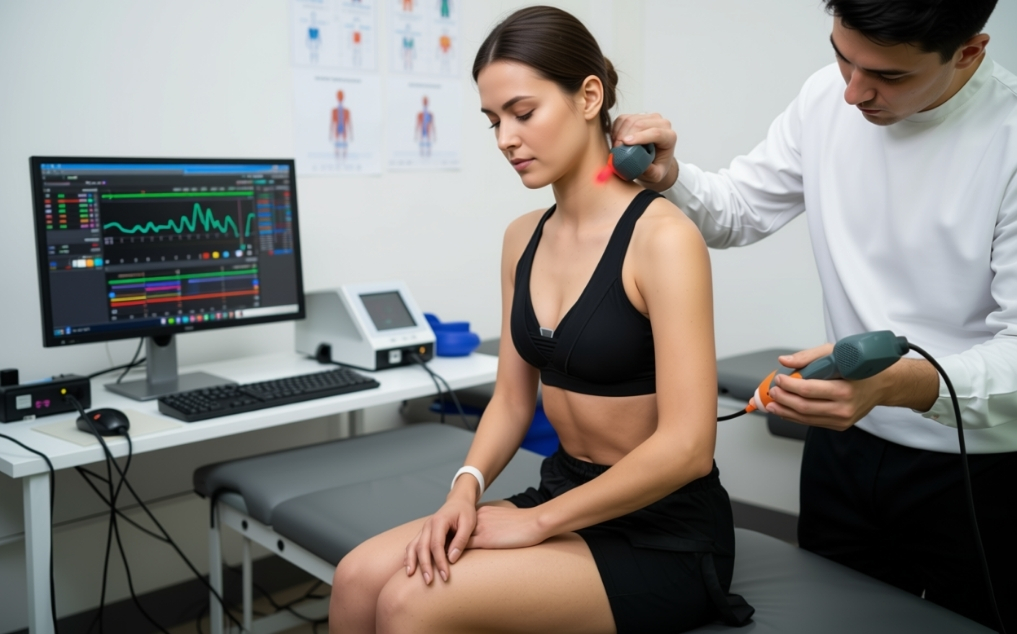

Migraines are debilitating, causing pain, nausea, light sensitivity, and lost productivity. Many people don’t realize that muscle tension, cervical spine issues, and movement dysfunction often drive migraines—problems that professional therapy can address. At StretchClub® in Yorkville, Dr. Alyssa Holum and Dr. Michael Scardina use personalized assessment, dynamic partner-assisted stretching, and PNF techniques to target the root cause, relieving migraines rather than just managing symptoms.
The Migraine-Tension Connection
Most people think migraines are primarily neurological problems requiring medication. While neurological factors exist, research shows that muscle tension and cervical dysfunction are significant contributors to migraine development. When your neck muscles are tight, your cervical spine is misaligned, or your movement patterns are dysfunctional, these mechanical problems create nerve irritation, reduce blood flow, and trigger migraine cascades.
Chronically tight neck and shoulder muscles—like the upper trapezius, levator scapulae, and suboccipitals—can compress nerves and restrict blood flow to the head, creating conditions for migraines. Misaligned or unstable cervical vertebrae further heighten nervous system sensitivity, lowering your migraine threshold. These factors are major contributors to migraine development for many people.

Personalized Assessment: Understanding Your Migraine Pattern
Effective migraine therapy requires understanding your specific migraine pattern and mechanism. We conduct a comprehensive assessment evaluating your cervical mobility, your shoulder and thoracic mobility, your postural alignment, your muscle activation patterns, and your movement quality. We also discuss your migraine patterns—when they occur, what triggers them, what makes them worse or better.
This assessment reveals whether your migraines are primarily cervicogenic (originating from neck dysfunction), tension-related, postural, or a combination. Someone might develop migraines from forward head posture and tight upper trapezius. Another person’s migraines might stem from cervical instability combined with poor movement patterns. Yet another might experience migraines triggered by stress-induced muscle guarding. Each person’s mechanism is different, and effective therapy addresses their specific mechanism.
The Migraine Relief Process
Migraine relief through personalized therapy follows a logical progression. Initially, we focus on releasing the acute muscle tension creating your immediate migraine risk. Dynamic partner-assisted stretching systematically releases your neck and shoulder tension, immediately reducing your migraine susceptibility.
As tension eases, we address the underlying dysfunction—postural misalignment, cervical instability, thoracic restriction, or faulty movement patterns. Using PNF, we retrain your nervous system to release protective tension, strengthen your cervical stabilizers, and improve movement quality. This systematic approach progressively reduces migraines by correcting their root causes.
Cervical Tension and Migraine Triggers
Chronic cervical tension is one of the most overlooked migraine triggers. When your neck muscles are chronically tight, they’re constantly irritating nerves and restricting blood vessels. Your migraine threshold—the point at which your nervous system activates a migraine—becomes lower. Even minor stressors that wouldn’t normally trigger migraines now do, because your baseline tension is already elevated.
Professional migraine therapy systematically releases this chronic tension. As your baseline tension decreases, your migraine threshold increases. Minor stressors no longer trigger migraines because you’re not starting from an already-elevated tension state. Many patients experience dramatic migraine reduction or elimination simply through systematic tension release, without needing medication changes.
Postural Correction for Migraine Prevention
Your daily posture directly influences your migraine risk. Forward head posture from desk work tightens your posterior neck muscles, strains your cervical spine, and creates the mechanical conditions for migraines. Rounded shoulders create muscle imbalances affecting your cervical stability. Poor sleeping position maintains spinal misalignment that triggers migraines.
Personalized migraine therapy includes postural assessment and correction. We identify which postural habits are contributing to your migraines, teach you better positioning, and help you maintain improved posture throughout your day. Combined with tension release and functional retraining, postural correction prevents migraine recurrence.
Movement Dysfunction and Migraine Susceptibility
Movement dysfunction—restricted mobility, weak stabilizers, compensatory patterns—creates constant stress on your cervical spine and nervous system. This chronic stress lowers your migraine threshold, making migraines more frequent and more severe. Additionally, certain movement patterns directly trigger migraines in susceptible people—looking up, turning your head quickly, or moving through restricted ranges.
Personalized therapy addresses your specific movement dysfunction. We restore your cervical mobility, strengthen your stabilizers, and retrain your movement patterns. The result is better cervical function, reduced nervous system stress, and dramatically lower migraine frequency.
PNF and Nervous System Retraining for Migraine Relief
Your nervous system’s sensitivity plays a key role in migraine susceptibility. PNF techniques retrain how your cervical muscles and nervous system respond to stress by stimulating proprioceptors through specific movement patterns. This reduces overreactivity, raises your migraine threshold, and prevents triggers from causing attacks. Unlike symptom-focused treatments, PNF addresses the root neurological patterns, producing lasting migraine relief.
Pilot Trial: PNF vs Static Stretching
A randomized pilot study compared the PNF contract‑relax technique versus static stretching in women with migraine. Both groups showed improvements in headache characteristics, migraine-related disability, and neck disability. While PNF did not clearly outperform static stretching in this small trial, the findings suggest that stretching combined with neuromuscular work can help migraineurs. The study size and design limit strong conclusions, but it supports the plausibility of a PNF-based intervention.
Lifestyle Factors and Migraine Management
While personalized migraine therapy addresses the physical mechanisms driving your migraines, lifestyle factors matter. Stress management, sleep quality, hydration, caffeine intake, and meal timing all influence migraine frequency. We discuss your lifestyle and help you identify which factors might be contributing to your migraines. The goal isn’t perfection—it’s understanding how your lifestyle influences your migraines so you can make informed choices. Some migraine triggers are unavoidable, but by addressing your physical dysfunction through therapy, you increase your resilience to these triggers.
From Frequent Migraines to Rare Events
Personalized migraine therapy doesn’t just reduce frequency—it transforms migraines from a life-defining problem into rare occurrences. By addressing the root causes—muscle tension, posture, and movement dysfunction—your nervous system recalibrates, physical dysfunction resolves, and migraine susceptibility decreases. Many patients experience only occasional migraines, and some achieve complete elimination, all without relying on ongoing medication.
Your Personalized Path to Migraine Freedom
Migraine freedom is achievable when you address the specific mechanisms driving your individual migraines. At StretchClub in Yorkville, we help you move from frequent migraine suffering toward lasting relief and freedom.
Start with a free consultation where we’ll assess your cervical function, evaluate your migraine patterns, identify the specific mechanisms contributing to your migraines, and explain how personalized therapy will systematically reduce your migraine frequency. We’ll discuss your history, your goals, and create a treatment plan designed specifically for your migraine pattern. Book your free migraine assessment, call (630) 882-9695, or email info@stretchclub.com to begin your path to migraine freedom today.
FAQs
Can migraines really be caused by neck problems, or is that just a theory?
Cervical dysfunction is a well-documented cause of cervicogenic migraines. While not all migraines stem from neck problems, many do. Our assessment determines whether neck dysfunction is contributing to your specific migraines. Even when migraines have other causes, addressing cervical dysfunction often reduces frequency and severity.
If I’ve had migraines for years, can therapy actually change them, or is this my new normal?
Long-standing migraines often respond very well to personalized therapy because the underlying dysfunction has been driving them for years. By finally addressing that dysfunction, you can achieve improvements you thought weren’t possible. Many patients report dramatic migraine reduction after years of accepting frequent migraines as unavoidable.
Will I still need migraine medication after therapy, or can I stop taking it?
This depends on your specific situation and your doctor’s recommendations. Many patients reduce or eliminate medication as their migraine frequency decreases through therapy. Others maintain medication but need it less frequently. Any medication changes should be discussed with your doctor, but many patients report needing significantly less medication after personalized therapy.
What if my migraines seem random with no obvious trigger—how would therapy help?
Even “random” migraines often have underlying mechanisms—cervical tension, postural stress, or nervous system sensitivity—that remain constant even if triggers seem random. By addressing these underlying mechanisms, you reduce your baseline migraine susceptibility, making migraines less frequent and less severe even if specific triggers remain.
How quickly can I expect migraine improvement from personalized therapy?
Many patients notice reduced migraine frequency or severity within 2-3 weeks as tension releases and nervous system sensitivity decreases. More substantial improvement typically develops over 6-12 weeks as underlying dysfunction is systematically corrected. Dr. Holum or Dr. Scardina will provide a realistic timeline based on your specific situation.
Is there anything I should avoid during migraine therapy, or can I continue my normal activities?
Personalized therapy is designed to be compatible with normal activity. We adjust intensity appropriately and teach you migraine-safe movement strategies. In fact, returning to normal activity with improved movement patterns is part of therapy. You’re not restricted; you’re learning better movement.
What if other treatments haven’t worked for my migraines—why would personalized therapy be different?
Previous treatments might have addressed symptoms without identifying your specific underlying mechanism. Our personalized assessment reveals the root cause unique to your migraines. Many patients find relief with personalized therapy after generic treatments failed because we’re treating your actual problem, not a generalized migraine protocol.
Can personalized migraine therapy prevent migraines, or does it only treat existing migraines?
Once we’ve addressed your underlying dysfunction and retrained your nervous system, prevention becomes possible. By maintaining improved cervical function and postural habits, you prevent the conditions that trigger migraines. Many patients achieve lasting prevention, not just reduction of existing migraines.